You pull up your charts in the morning and the stock that’s up 4x ran without you.
It feels like you missed the trade. Somebody quicker and smarter caught it.
You don’t suck…
It’s impossible to catch every move. Even on the stocks you’re watching.
Today at 10:30 a.m. ET, see why I think these 4 stocks could turn $1,000 into $4,250 in just hours…
I miss most of these runs too (and I’m looking for them every day).
Missing the first run doesn’t mean the trade is over. But simply buying every pullback is a great way to get your face ripped off.
So before I consider trading a stock that’s already moved, I follow one rule:
Here’s how I trade the second leg.
PDS Biotechnology Corporation (NASDAQ: PDSB) went up about 4x in 3 sessions in September. The top of that run was $1.06.
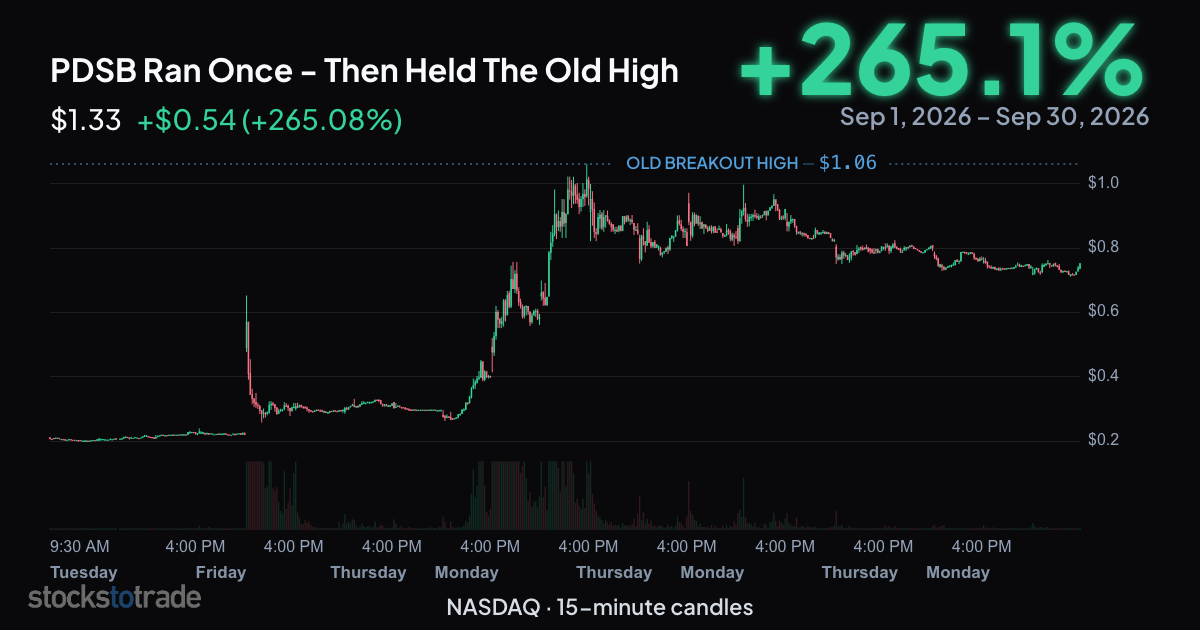
For 2 weeks after that run the stock drifted lower. Then on October 5 it popped again, and instead of chasing the pop I watched where it came back down to. It came back to $1.06, the top of the September run, and closed right on it on October 7.
The next day was the test. It dipped under $1.00 during the session and closed back above it.
A pullback that goes under the level and closes back above it has held, and a hold at the old high is the second-leg entry.
So on the morning of October 9 the trade was there:
- Buy at $1.07, or anywhere up to $1.15.
- Risk $1.00, just under the level that held. If it trades back under, the hold failed and I’m out for 7 cents a share.
- Sell about half once it’s up 10% to 15%, which is usually day 2 or 3, and keep the rest.
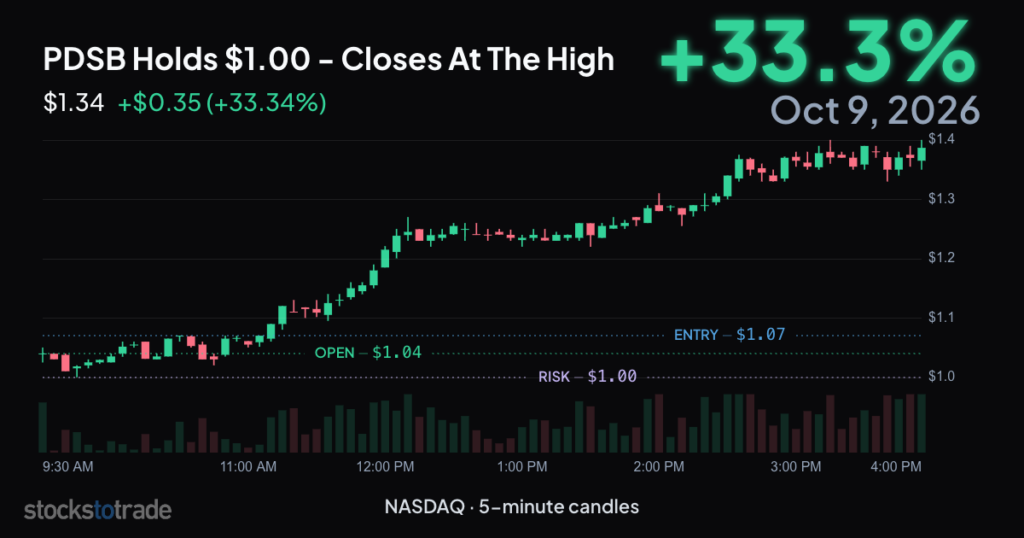
It held $1.00 that morning and closed at $1.38, the high of the day. A buyer at $1.07 was up 29% in 1 session and already selling half.
Here’s the other half of the rule. That entry has a short life. By the time I was looking at the chart that afternoon, the stock was in the mid $1.30s, and I said don’t buy it up here.
The entry was the hold at the old high. Once the stock is 30% above it, you’re not buying the second leg anymore. You’re chasing it.
On Monday it opened at $1.48 and on Tuesday it traded as high as $1.79. By Wednesday’s close it was back to $1.41.
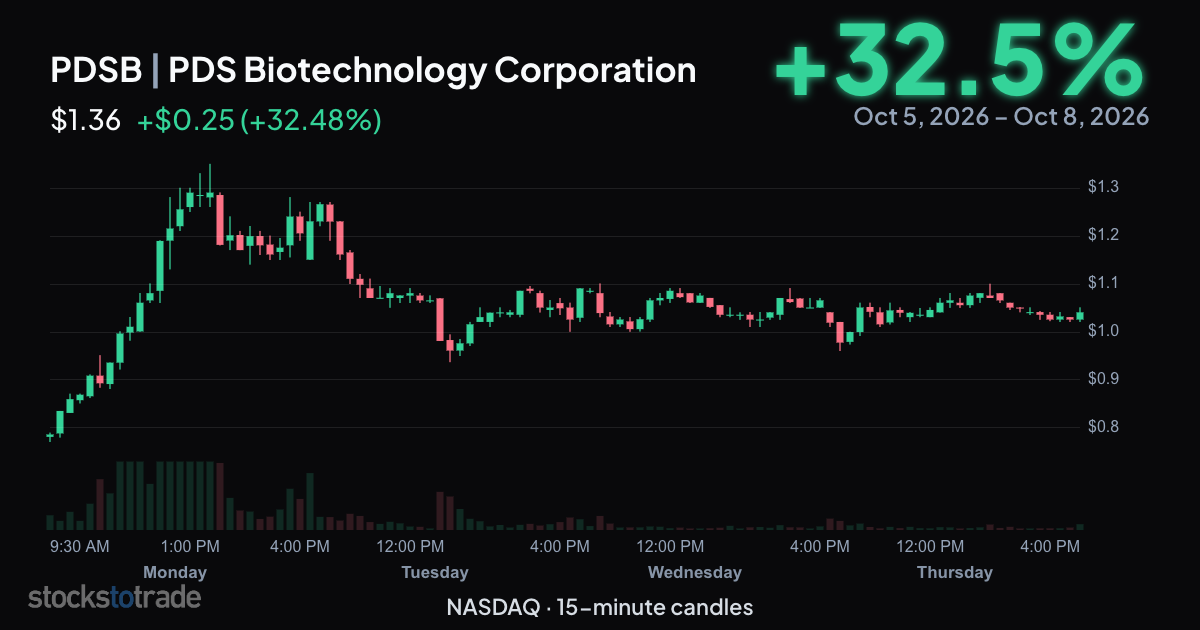
The buyer who took the hold at $1.07 never saw his risk trade and was still up about 32% at Wednesday’s close. The buyer who chased Monday’s open was down 5% at the same close. The entry rule did its job.
Then on Wednesday the stock fell 11.88%. The same day, the company filed with the SEC to register shares for resale by 3 investors. Here’s what the filing says:
- About 110M shares registered for resale.
- The investors’ cost is about $0.28 a share, from a private placement that closed on September 14.
- About 16.5M of the shares are stock they already hold. The rest come from warrants they can exercise at $0.22 or less.
- The company had about 105M shares outstanding on October 9.
So the 3 investors can sell more stock than the company had shares. Their cost is $0.28 and the stock closed at $1.41. They were up about 5x.
And they had been there since September 14. Their placement closed before PDSB ever traded $1.00 and before that entry existed.
When I walked through the chart on October 9 I didn’t bring up the placement. The chart was clean and the floor held, and that was all I looked at.
Here is what the filing changes. An investor who paid $0.28 is ahead at any price above it. The day the SEC clears the registration, he can sell at whatever the price is. His orders sit above the price and cap how far it rises. Until he’s done selling, every move up runs into his stock.
I don’t buy a stock with that much supply coming. A position I already have in one gets sold into strength and not held for the next leg.
The chart was right. The floor held and the stock paid. None of that told me who owned the shares under that entry or when they could sell them. The filing did, 3 sessions late.
Before the next pullback I buy, I look that up first. Who holds stock at a cost below my entry, and the date they’re allowed to sell it.
At 10:30 AM today I’m going LIVE with Tim Sykes to show the system I built to find these setups before they run, and the 4 stocks it’s pointing at right now, with a plan for each.
Stay sharp,
Jack Kellogg
*Past performance does not indicate future results