
The midterms are getting the blame for this selloff.
Democrats won both chambers of Congress Tuesday, and tech stocks got crushed.
Crazy volatility can lead to giant moves.
By Thursday’s close, the S&P 500 fell 4.36%.
The last time we had a midterm sell-off like that, people drove to work in a horse and buggy.
And “chip stocks” would have been something you used to make soup…

But this week, the “chips” from this century took a huge hit. The Philadelphia chip index fell 12%, its second-biggest drop on record.
Retail traders were dumping stocks too. By that afternoon, they were on pace for their biggest day of net selling since March 17, 2020.
The worry is that a Democratic Congress will slow down the AI build-out, especially the data centers.
I get why that scares anyone holding tech. But I wanted to know what stocks actually did after past midterms, especially the ones where Democrats took Congress.
So I went back through every midterm since 1946. The S&P 500 was higher a year later after all twenty of them, including every time Democrats took Congress.
That doesn’t mean I’m buying tech here. I’ve traded this whole year like 2022, the last midterm year. That means no chasing breakouts. I wait for a big flush, then I buy the dip.
I already know where I’m waiting for that flush.
Here are the exact prices I’m watching.
Right now, I’m waiting for a big flush in gold and silver.
Both got hammered on October 30 and broke important support. Since then, silver has bounced instead of flushing. It closed at $49.59 on November 3 and was trading around $52 on the afternoon of November 6.
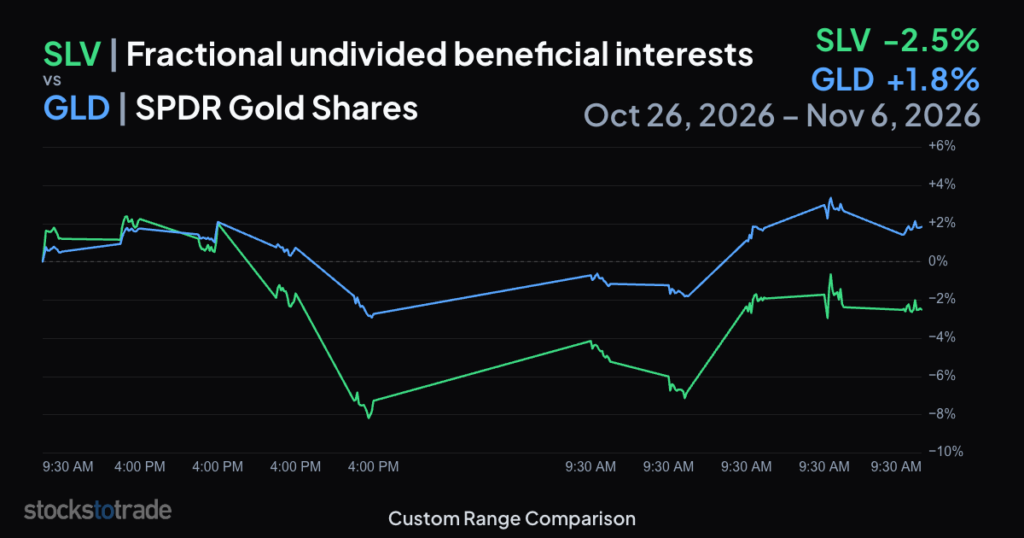
I’m not rushing into either one. I’d like to see one more ugly down day with heavy selling first. Here’s where I’m watching:
- Silver: $45 first, about 13% below where it traded on the afternoon of November 6. A flush toward $40 would be even better.
- Gold: $3,500 to $3,600, roughly 12% to 14% below where it traded that same afternoon.
Those are the prices where I’d start paying attention.
What I need to see there is a washout and then a reversal on heavy volume. If I get that in either metal, I think it could bounce hard.
As for tech, I’m not betting against it for the long haul. The midterm history is a big reason why.
Across all twenty midterms since 1946, the S&P 500 gained 14.8% on average over the next year. Democrats took control of at least one chamber four times in that stretch. Here’s what the S&P 500 did over the next twelve months:
- 1954, Democrats won both chambers: up 33%
- 1986, Democrats won the Senate: up 2%
- 2006, Democrats won both chambers: up 10.2%
- 2018, Democrats won the House: up 12.3%
Every one finished higher. Two of them came with a catch.
The 1986 year included the October 1987 crash, when the Dow fell 22.6% in a single day. Stocks still finished that year up 2%.
The 2006 year finished up 10.2%. The 2008 crash came the year after.
2018 is the closest match to right now. Democrats won the House on November 6, and the S&P 500 fell 14.7% from its election-day close to its December 24 close.
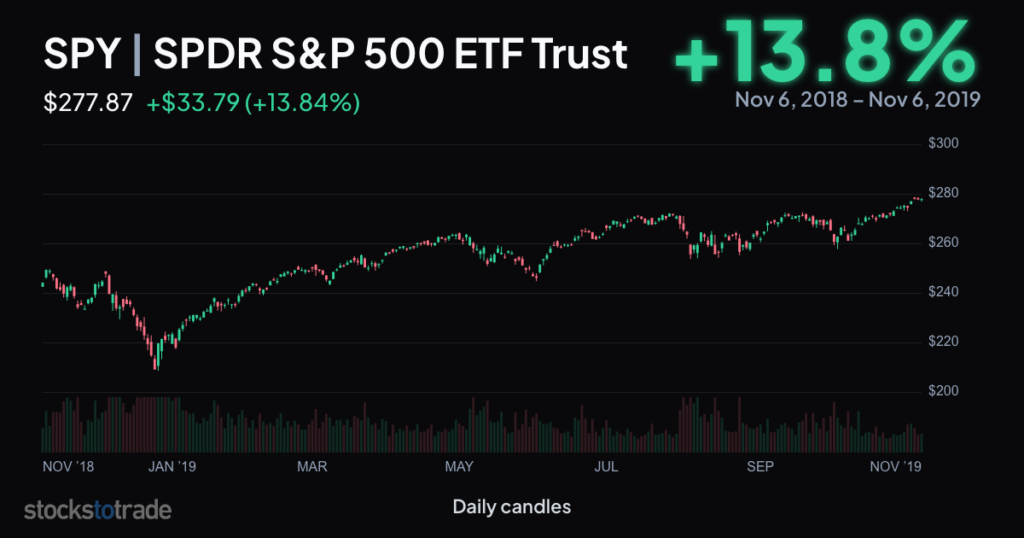
A year after the election, it was still up 12.3%.
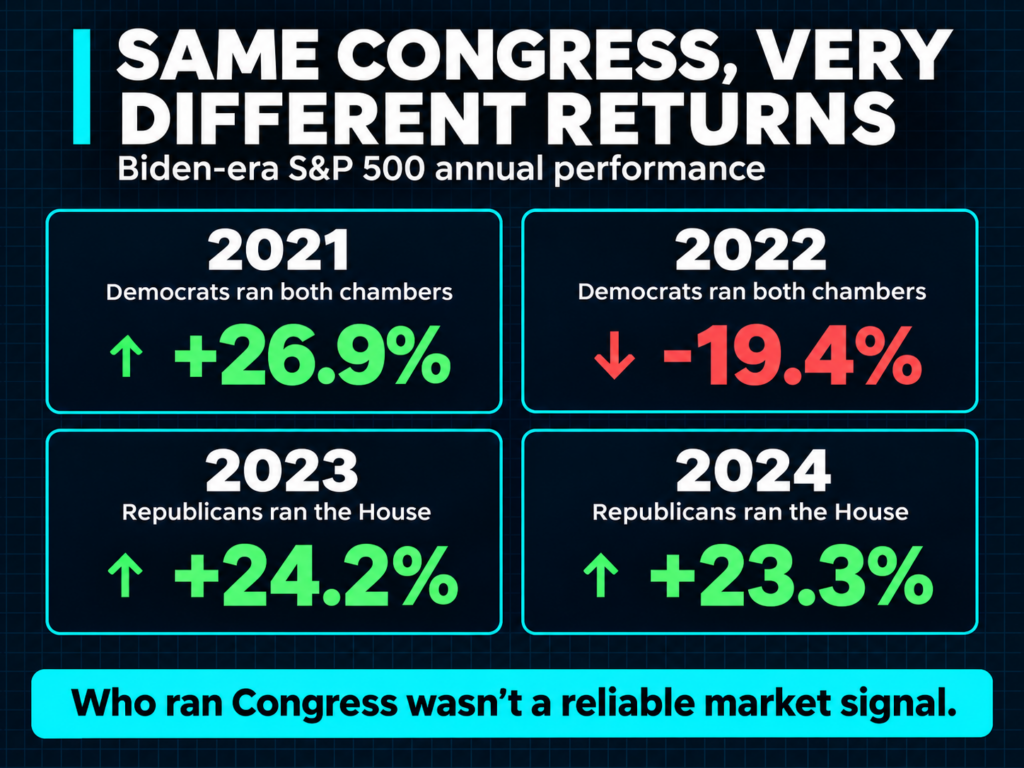
Under Biden, which party controlled Congress didn’t tell you much either. His best year and his worst year came with the same Democratic Congress:
Selling everything because of who won a midterm would have been the wrong call a year later every single time since 1946.
Some of the worry about data centers is real. Voters backed limits on data centers in 40 of 41 local ballot measures.
Those were local votes, though, and no company has said a project got delayed because of them.
Tech was also sliding before anyone voted. On October 30, tech stocks lost more than $1 trillion in value over doubts about AI spending.
And on the day of the big drop, Microsoft was reported to be tightening oversight of its data center deals with smaller cloud companies.
Anybody can make money when everything’s going up. The real test is how many chips you keep on the table when it’s falling.
So I’m keeping mine on the table and waiting for the flush, no matter who runs Congress.
Get eyes on the biggest moves with this tool.
Stay sharp,
Jack Kellogg
*Past performance does not indicate future results