

Low-float runners are spiking almost every day.
When the market closes, my scanner ranks the day’s biggest movers by percent gained. The names at the top of the list are almost always low-float companies with only a small number of shares available to trade.
Any extra attention from a catalyst can run the price up insanely fast because there’s just not enough shares to go around.
But that same thinness also sends it crashing back down just as fast once the buyers stop.

So how do you time the run and print gains on these scary-looking roller coasters?
After a vertical run the share price often stalls at the top before it rolls over. That stall at the top is the signal that the run is about to end. And that’s the moment I’m waiting for…
Most retail traders can’t buy shorts, and you don’t need to. If you already own one of these runners and it spikes, the stall is your exit.
The trap is staying in too long. The crowd holds through the stall hoping for one more leg, then watches the stock round-trip, falling all the way back to where they bought it and handing back everything they were up.
The real discipline in trading these names is selling while the price is still high and the buyers are still there…
How I Short Runners
If you have the ability to short stocks, the runners can be an easy payday from the short side.
Take UPC last week.
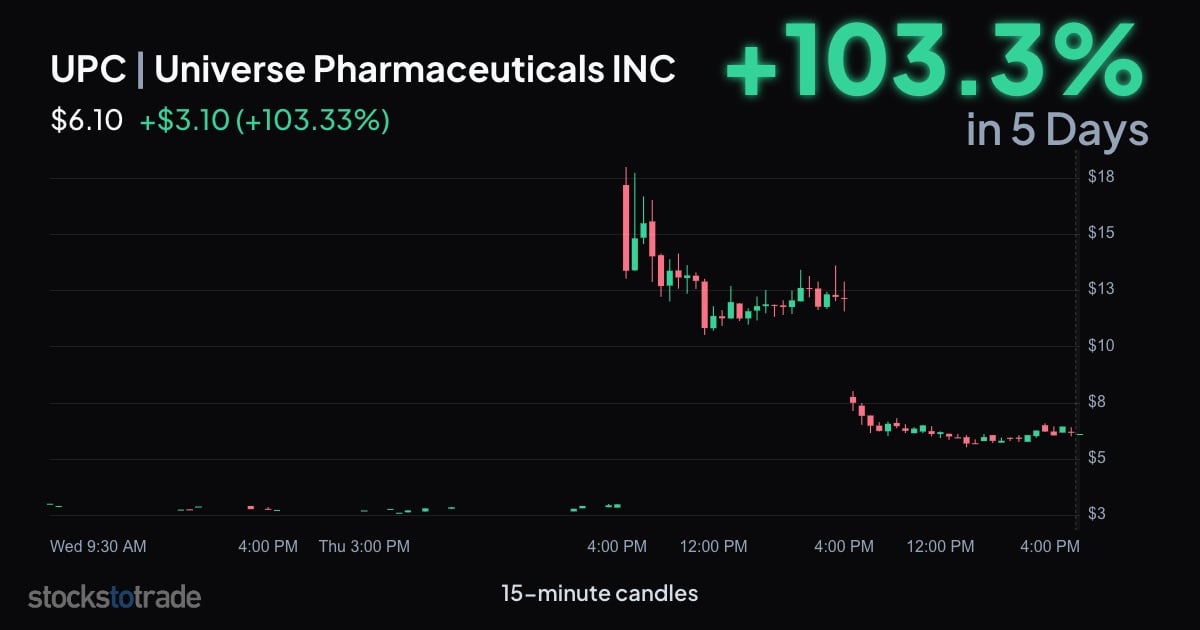
It ran from about $3 last Friday to $12.18 by Monday’s close, up 311% in a single day, and touched roughly $18 intraday before it turned. The float is around 640,000 shares, so a small batch of orders walked the price all the way up. Once the buyers were done, there was nothing underneath, and the fall matched the run.
By Tuesday’s open it was already cracking. It opened near $7.70 and slid to about $5.90 by midday, roughly half of Monday’s close.
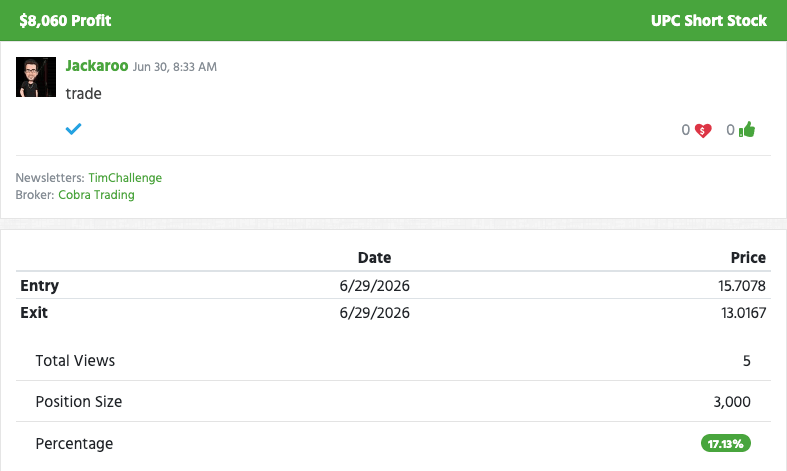
I shorted UPC for $8,060.*
The Risk of Shorting
The UPC short was a tidy little trade. But shorting a small stock like that can easily wreck you. You sell first and buy back later, so if the price keeps climbing, there is no limit to the loss.
The borrow is often expensive, and a lot of the time you can’t get the shares at all. Many brokers won’t let you short something this small. This is not a beginner’s trade.
But there are plenty of opportunities for a small account to catch these runners on the way up and sell into strength…
The move on UPC is what Tim Sykes calls a supernova. A tiny company, usually under $100 million market cap, that catches a news catalyst and spikes hard in a single day before it gives most of it back.
I trade these. They’re the heart of how I built my career, and I learned to spot them years ago from Tim, back when my trading was going nowhere and I needed something I could actually repeat.
What changed things for me was the system, a repeatable way to find a supernova before it pops. The float, the catalyst, the volume, the failure point, all of it on one checklist so I stop guessing and read the same setup the same way every time.
Once I had that, UPC stopped being a gamble and became a setup I could see coming.
Tim built that whole system into a short training and a cheat sheet. It runs $7, and if it does nothing for you, you get your money back. He even put some of my own trading in it so you can see the method in action.
Sign up for the supernova training with Tim Sykes right here.
Stay sharp,
Jack Kellogg
*Past performance does not indicate future results