
Hey traders,
Last week was kind of like a “how-to” and a “how-not-to” all rolled into one …
On Tuesday, February 17, I walked away with a massive $28,768 gain on Signing Day Sports (NYSE: SGN).
But that same day, I took a painful $4,716 loss on Reddit (NYSE: RDDT):
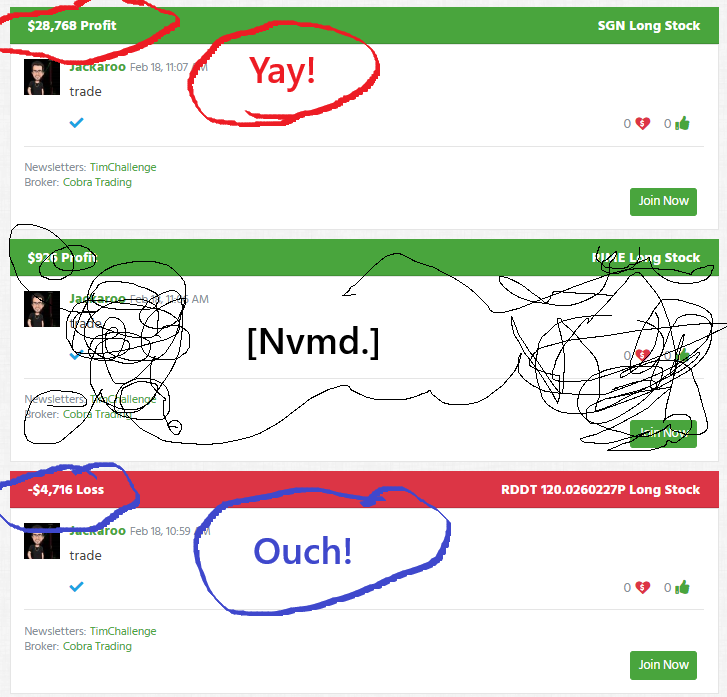
Same trader, rules, and psychology, but two completely different outcomes.
Now I’ve got one job…
To figure out why one trade worked (and the other didn’t).
That way, I can maximize which moves lead to wins and minimize the ones that lead to losses.
Let me show you what I did right (and wrong) on these two trades.
Good News First
Signing Day Sports had already caught everyone’s attention the week before when it gapped up around 80%.
After that explosive move, it formed a clean two-day bull flag heading into the long weekend.
That’s a setup I love. It means the stock is consolidating but holding strong as traders watch and wait.
Over the weekend, SGN was all over people’s watchlists. Everyone saw the potential for a second leg higher once the market reopened after Presidents’ Day.
When Tuesday came, SGN did exactly what I hoped it would.
It exploded.
Around mid-morning, as SGN pushed out of its range, I went long at $0.335
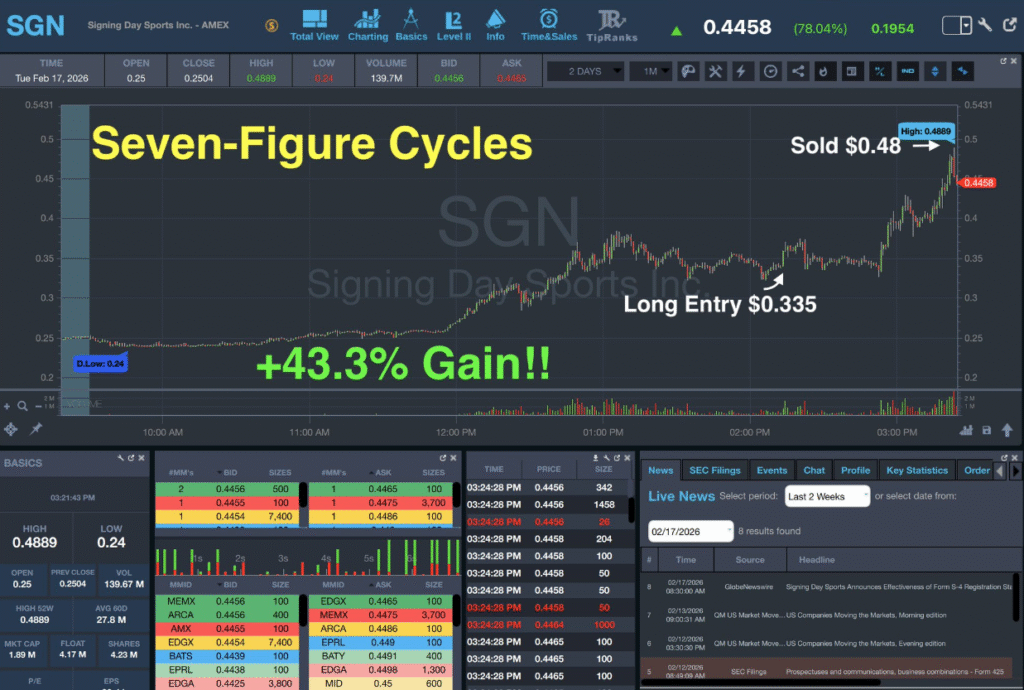
The chart showed rising volume, tight spreads, and buying pressure pouring in through every level.
What I liked most was that the confirmation wasn’t random. SGN was loading up for another run, right in front of anybody paying attention.
Riding That Wave
Less than two hours later, SGN was up nearly 43%, and I sold into strength at $0.48.
It was one of those trades that work out the way you plan them on paper, with a clean entry, a strong breakout, and a decisive sell before momentum faded.
This wasn’t about luck. It was about respecting the setup, waiting for the right moment, and letting market psychology do the rest.
That day became a perfect reminder of how post-weekend momentum can fuel big moves in low-float stocks.
When you combine that with a bullish pattern and strong liquidity, everything lines up.
Now, the Bad News …
I didn’t manage RDDT the same way, and that’s why it taught me a lesson.
For days, the stock had been breaking below support levels that told me buyers were backing off.
Still, I wanted to be early on what I thought might be a bounce.
I bought too soon, ignoring the clear downtrend and volume weakness that should have kept me cautious.
When the stock kept dipping, I hesitated.
I didn’t respect my stop level, hoping instead for a reversal.
But hope is the quickest way to turn a small red trade into a bigger one. By the time I finally exited, the loss was larger than it needed to be.
The Lesson Here
What makes these two trades so powerful when we look at them side by side is how clearly they show the difference between being confident and acting emotionally.
SGN worked because I trusted the setup that history and experience told me had a high chance of succeeding.
RDDT failed because I wanted the chart to behave the way I wished, instead of the way it actually was.
Day trading isn’t about being right all the time, though — it’s about managing yourself, your risk, and your reactions.
The SGN trade reinforced my trust in technical setups that build energy before breaking out.
The RDDT trade reminded me to stay loyal to my process, even when I think I might be smarter than the chart.
When it comes to the SGN example, be that guy or girl.
When it comes to RDDT, don’t be.
Stay focused,
Jack
*Past performance does not indicate future results. Results not typical.