Tell me if this sounds familiar…
You’ve got a well-thought-out thesis on a name you like. It starts to move just like you predicted, so you take the trade.

Then the trade goes against you almost right away. Now you’re sitting there wondering if you were wrong, or if you were just early.
This week I took 4 trades on the same name. The first 2 went against me. The last 2 trades made my money back and then some.
There was a time in my career where I never would have considered that third trade.
Let me walk you through it…
The week before, the whole chip group got hit hard. The headlines were all AI fatigue and semiconductor uncertainty.
Over the weekend, I put SNDK on my watchlist with one rule. If it holds its prior close, its prior VWAP, and its prior high of the day, it’s a long. If it fails those three levels, I’m shorting it.
Then Monday morning, chips bounced hard. My bet was that the bounce was short covering, not actual demand, and that SNDK would fail.
So that Monday, I shorted it.
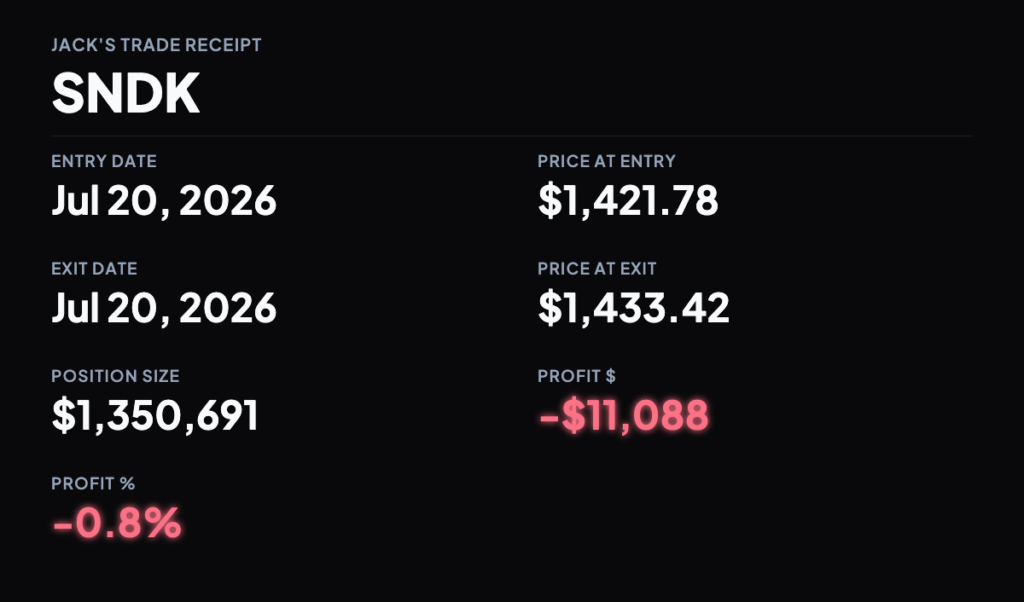
I was too early. The bounce wasn’t done, SNDK popped with the group, and it squeezed me out for about $11,000.
Tuesday, I shorted it again, and it did the same thing!
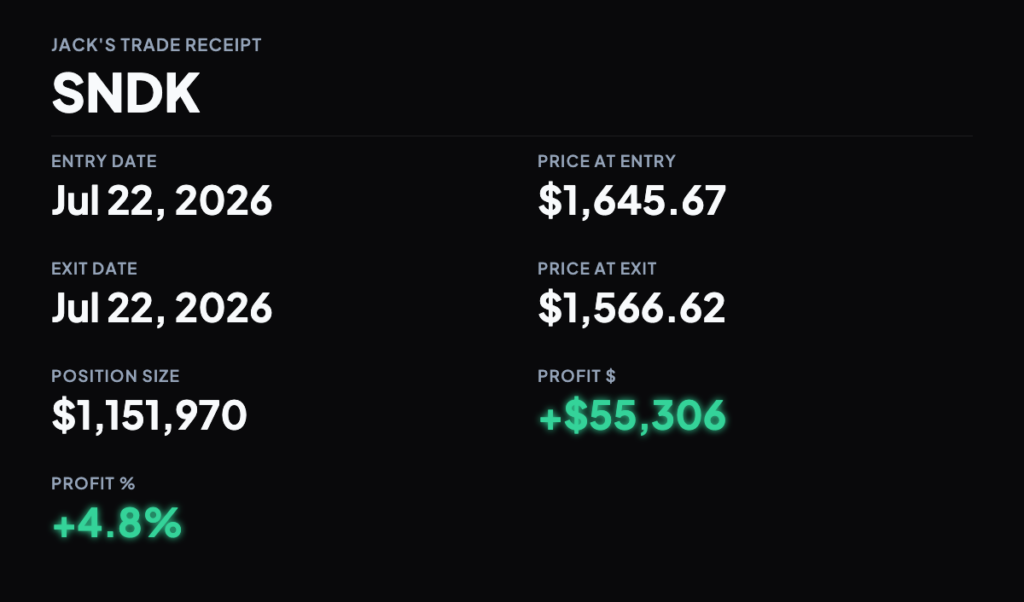
The bounce still had gas in it, and it ran me over for about $28,000 more.
That was two days of shorting the same stock and close to $40,000 gone. But my read hadn’t changed one bit.
That’s the part most people get wrong. A loss doesn’t automatically mean the idea was bad.
Sometimes your idea was good, but your timing was bad…
SNDK hadn’t proven me right yet, but it hadn’t proven me wrong either. It just hadn’t confirmed.
By Wednesday, it faded. SNDK ran up into the morning, then rolled over and started failing the same levels I’d been watching since the weekend. This time the timing matched the read.
So I shorted it again. It was the same ticker, same direction, same thesis as the two losers.
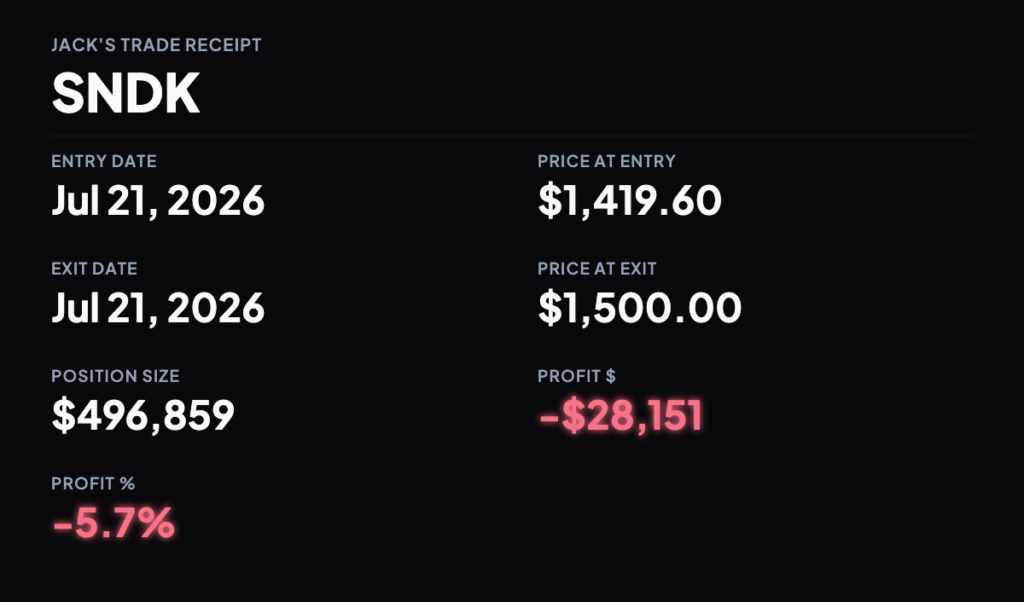
It gained $55,306.*
Minutes later, I hit the idea a second way. I bought SNDQ. That’s a fund built to move twice the opposite of SNDK, so when SNDK drops, SNDQ rises about double. Going long SNDQ is just another way to be short SNDK. That one gained $45,145.*
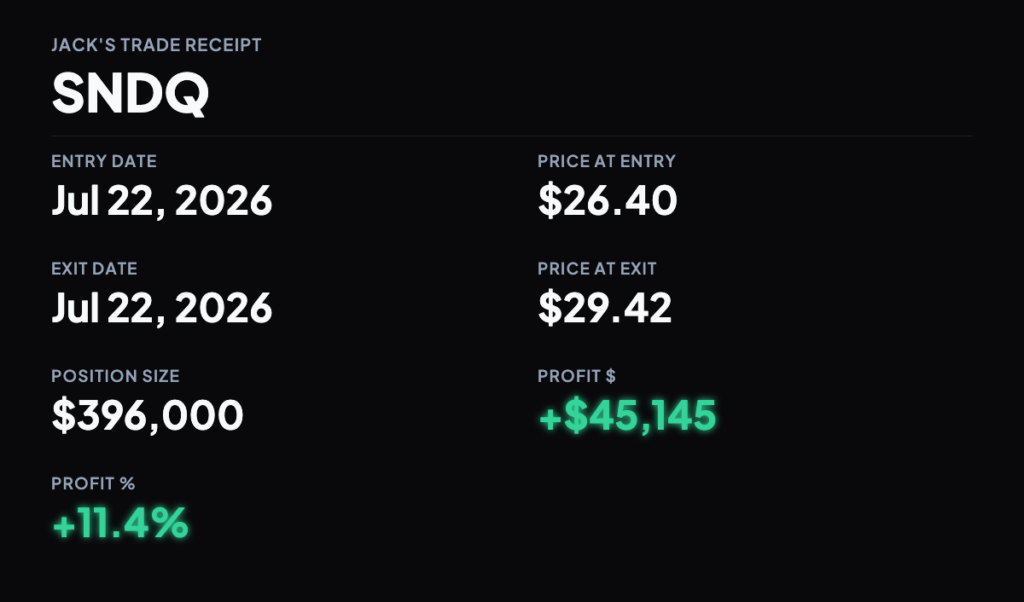
That’s about $100,000 in a single morning, right after dropping close to $40,000 shorting the same stock the two days before.
Now, I run these from an account built to take that kind of size, and the leverage on a fund like SNDQ cuts both ways. (2x the gains means 2x the losses).
My thesis on SNDK never moved from Monday to Wednesday. Every entry had merit. The first two days I was early, and the bounce squeezed me. The third day it confirmed, and it paid. I didn’t drop the read after two losses. I waited for the setup to prove itself, then hit it again.
This is the biggest earnings week of the year, with Alphabet, Tesla, Intel, and Meta all reporting. A sector that big moving through earnings throws off huge moves in both directions.
So take any related name and mark the three levels: prior close, prior VWAP, prior high of day. If it holds all three, it’s a long setup. If it fails one, it’s a short. Then you wait. You let one side confirm before you put money on it.
And when a small loss shows up while you’re still waiting for that, don’t read it as proof the plan is broken.
Until these earnings settle the rest of the sector, that’s the whole game. Mark your levels, and wait for one side to prove itself before you act.
Stay sharp,
Jack Kellogg
*Past performance does not indicate future results