Tell me if this sounds familiar…
A stock goes vertical and you’re locked in, watching every tick, trying to figure out if you’re still in the good part of the move.
If you were trading the watchlist I posted last Tuesday, you would have easily caught an entry on the rocket ship Sadot Group Inc. (Nasdaq: SDOT)
If you missed it, don’t worry…
You might catch the next runner here.
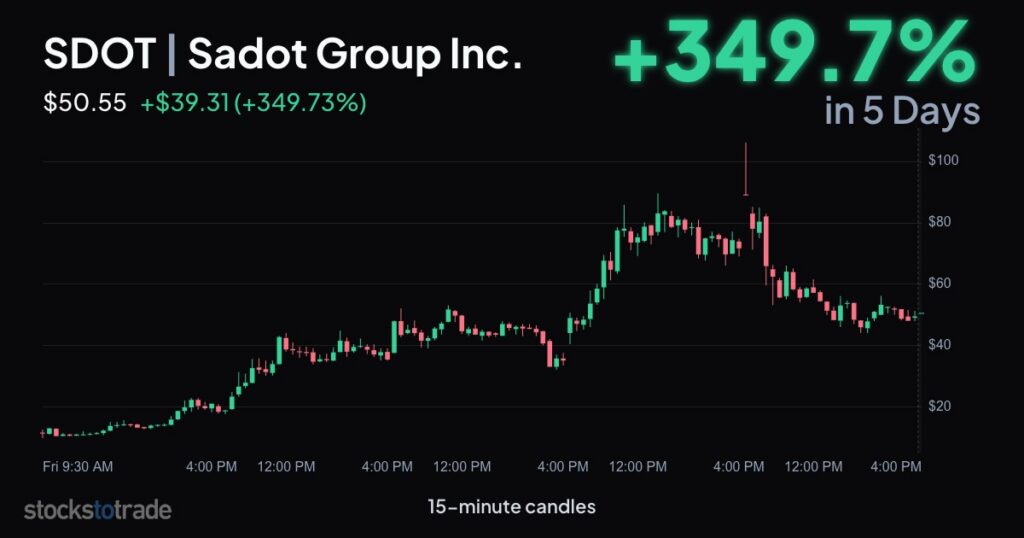
The stock ran from around $6 to nearly $90 in a couple of weeks. Then it dropped more than 30% in one hour last Wednesday.
If you’re in a stock that goes ballistic (like SDOT this week), the hardest thing to do is calmly take your gains..
So when do you take your gains?
You have to know which part of the move you’re in…
The 3 Parts of a Momentum Move
Like a lot of these low-float runners, the SDOT trade had three distinct parts to it.
The Spike
The spike is the first move off the base. Price pops because momentum showed up. No level held it.
There’s no established level to key an entry off yet. The stock hasn’t found one. That means entry timing is a guess, and nobody nails the spike entry twice in a row.
I don’t trade the spike. The spike can pay. There’s just no repeatable setup to trade it, so I let it go and wait for a level to form.
The Middle Window
Price pulls back from the spike high and holds a level. Volume keeps climbing while the stock sits on that level. A level that holds while volume climbs is what I’m watching for.
When the level holds, the shorts start covering. They see the stock isn’t breaking down, so they cover to cut their losses. The covering piles on buying pressure, and that pushes the stock into the next leg higher.
I enter when the signals line up. The level holds, volume stays elevated or rises, the covering kicks in, and I’m in. I take the meat of the move off the middle window, not the whole run.
Then the window closes and I’m out before the extension.
The Extension
By the extension, price is often 200% to 300% above its base. Volume is thinning out, and the easy move is gone.
The crowd piles in at the extension. People are buying because the chart is going up. There’s no level holding it up.
Traders that bought SDOT during the extension got wrecked when it dropped more than 30%.

Holding a runner past the top is a real kick in the pants. That’s why you need to know which part of the move you’re trading…
Here’s how the three parts played out on SDOT.
I had $20 mapped as the entry level, with a $30 to $40 target.
That Monday, June 29, SDOT opened right at $20. It ran to $44 by early afternoon. The entry and the exit were in my watchlist before the stock ever moved.
Anyone who followed my plan could have made easy gains off the middle window.
Take the meat of the move. Be out before the extension starts.
The Right Way To Trade These Moves
It’s all about the work you do before the trade. You map the level in advance, while the chart is quiet.
Mapping a level isn’t complicated. You want a name that’s already had a big run and then pulled back to a price where buyers have stepped in before. That earlier price is your entry level.
Ideally, you also want a reason for buyers to come back (like a news catalyst or a fresh volume spike).
Then you either catch the middle window, or you miss the trade. (There’s no third option).
If you’re not watching that exact name when the level holds, you never get the entry.
And if you are watching, you’re making the call under pressure with money on the line.
Now you’re reading the tape as fast as it prints and hoping you read it right…
My Power Signal watches for that setup (so you don’t have to sit on every ticker all day.
The alert fires before the name runs…
Stay Sharp,
Jack Kellogg
*Past performance does not indicate future results