The types of trades I’ve made my millions on move hundreds of % in a day. If you try to time a perfect entry on one of these supernovas, it can feel like hopping on a moving train.

But there’s a second setup that often shows up the next morning…
These runners will blast off and come crashing right back down. Often in just a few days…
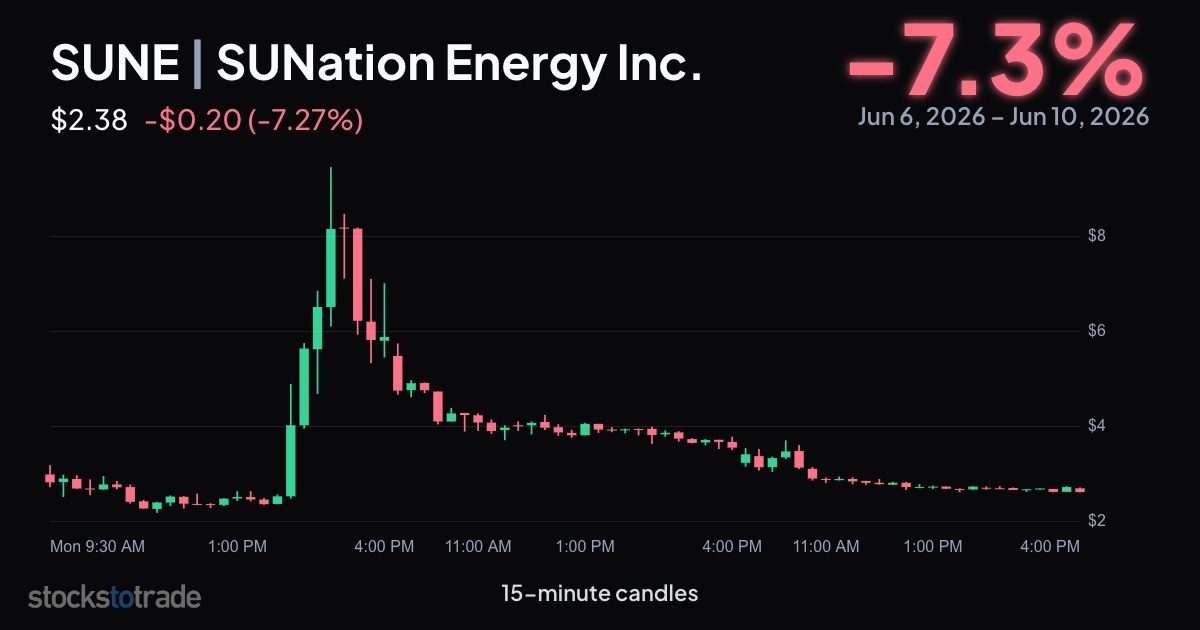
SUNE ran 700% that same week and gave almost all of it back. Holding overnight is a risk that you have to consider.
So before I hold one of these runners overnight, I make sure the chart looks healthy. If there are any red flags showing up going into the close, you have to cut your losses right then and there.
That’s the challenge. It’s hard to take a loss when there’s still a good chance you could be in the green the following day…
But the reason I’ve made over $25 million in trading profits is that I’m obsessed with protecting my risk. And it’s how I’m able to enter enough of these setups to stack profits…
How I Size Trades to Stack Gains
The types of setups I trade only lead to meaningful gains if you can stack them. You need enough irons in the fire to stack the winners and cut the losers quickly.
Most experts recommend risking no more than 1% of your account on any one trade. On a $26,000,000 account, that’s $260,000. The strategy scales to accounts of any size.
Especially now that the PDT Rule is over and traders under 25,000 are no longer limited to three trades a week.
You’ve gotta understand the difference between position size and actual risk.
A $10,000 position size isn’t the same as risking $10,000…
How to Define Your Risk
A $10,000 position might sound big to you. But a $10,000 position with a 5% stop-loss only risks $500.
A 15% move on that $10,000 makes $1,500. You risk $500 to make $1,500, and the percentages are the same whether you trade $10,000 or the size I do.
The same week I made money on AZI and PAVS, I lost five figures on NPT and on DEVS, and I cut both the moment they broke the level I bought them against.
Win three of these and cut two fast, and you still come out well ahead. Each winner brings in more than three times what a cut costs you.
At $400 a loss, it would take 25 straight losses to wipe out your account.
Losing 25 straight trades would be an impressive feat in itself. It’s extremely unlikely if you have any idea what you’re doing. Even a broken clock is right twice a day.
How To Find The Right Setups
Setting your entry and stop on these is mechanical once you know what you’re looking for.
This is my checklist…
Before I buy:
- The stock has already had its big run. It ran hundreds of percent and the first spike is over.
- It’s stopped falling and is holding a clear level, a price it keeps bouncing off instead of bleeding straight down.
- It reclaims that level on heavier volume than it pulled back on. That tells me buyers are stepping back in, not just a bounce that fades.
- There’s a higher level above it to aim for, so the upside is at least three times the distance down to my stop.
The entry and the stop:
- Buy just above the level it’s holding.
- Put the stop just under that level, usually a few percent down. That gap is my whole risk.
- Size it so getting stopped out costs a small, fixed amount.
The exit:
- Sell into strength while it’s still rising, usually the next morning’s pop. I don’t wait for the top.
- If it breaks the level I bought against, I’m out that same day. I don’t sit and hope.
- If it stalls or puts in a lower high, I take what’s there and leave.
- I never hold a broken chart overnight.
When I pass:
- It’s still falling with no clean level to buy against.
- The reclaim comes on weak volume.
- There’s no room to a higher level, so the three-to-one isn’t there.
Most importantly: You don’t have to catch the full 700%, nail the top, or call the exact bottom.
Take your gains early, cut your losers quickly. If the stock keeps running after you sold for gains, who cares? If you take a small loss, move onto the next one.
This is my full playbook for finding these runners, sizing them, and cutting losers before they hurt is where I walk you through all of it. It’s the same process that took my $10,000 in valet savings past $25 million.
Stay sharp,
Jack Kellogg
*Past performance does not indicate future results