The Nasdaq just put up its worst day of the year on Friday. If you’ve been watching this rally from the sidelines, Monday looked like the opening you’ve been waiting for…
Yesterday morning, the market absolutely ran over those buyers. If you were one of them, you could have avoided that big wipeout…

You don’t need a crystal ball to figure out exactly when to get in on a market-wide dip. Here’s a hint:
It’s not on day one.
Let’s look at the timeline:
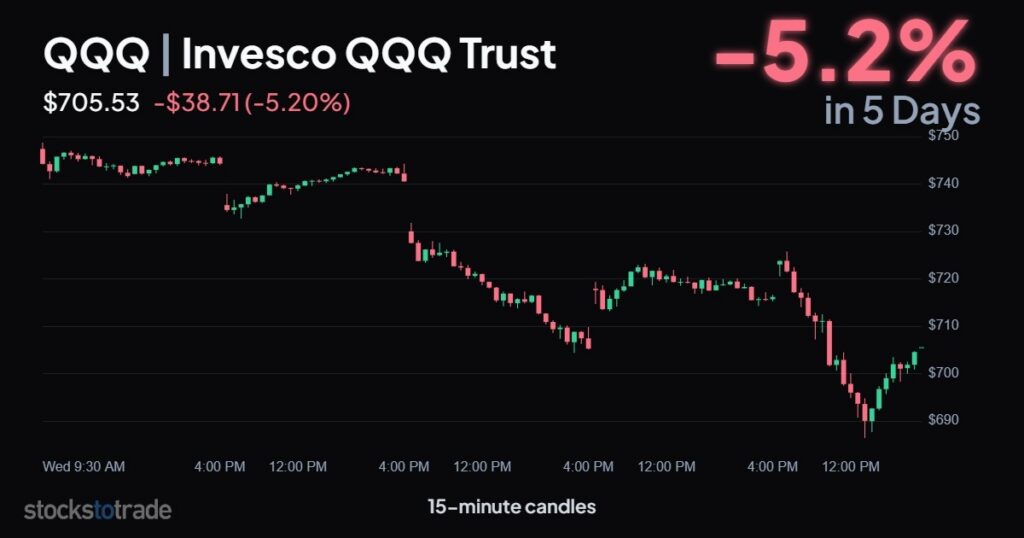
Friday: the Nasdaq fell 4.2%, about 1,100 points, its worst day of the year, with the chips dragging everything down.
Monday: a quiet, choppy session that closed green, up 0.86%. Enough of a push to make it look like the bottom was in.
Tuesday: the market popped early on Nvidia’s Jensen Huang telling everyone to buy the discount, then rolled over. By midday, it had given back the bounce and was trading at new lows, with Nvidia down around 6%.
Monday’s tape is what traders call a dead cat bounce.
It’s the thing I’m checking for the day after the first big red day. And if you don’t know how to spot it, you could be catching a falling knife instead of riding a bounce to new highs.
How I Time My Entries
One big red day does NOT make a bottom. When an index sells off hard and fast like it did last week, it rarely just reverses immediately. There’s usually more selling to come.
The first green day can be deceiving. After a hard drop, it feels like the all-clear, and that relief is what pulls sidelined money back in.
But the selling pressure hasn’t gone away completely yet. It ebbs and flows at key price levels set by huge Wall Street funds.
They’ll say, “We’re buying the index here, we’re re-shorting it here.”
Then the sellers take back over. The index rolls right back down and takes out the previous lows, trapping the people who bought the bounce.
Scroll up to the first chart I posted and you’ll see a perfect example of this.
That’s called a dead cat bounce.
A real bottom looks different. It makes a higher low, then puts up a second green day that holds its gains into the close on strong volume.
That second green day still hasn’t shown up.
Wait For Proof
Don’t buy the dip until the chart proves itself.
Avoid doing anything on the first red day, and don’t trust the first green bounce.
Wait for the second up day that holds, then buy the reclaim of the prior day’s high as the volume comes in, with a stop just under the recent low.
If that second day doesn’t hold (which it didn’t this week), there’s no trade. And no trade is a perfectly good answer.
Have we seen the low yet? I don’t know. Nobody does. But we can get huge clues by simply watching the index and being patient…
You don’t have to nail the exact bottom to make money on the recovery.
Waiting one more day for confirmation has far better risk/reward than trying to catch a falling knife.
Sitting in cash costs you nothing.
Let the index prove the bottom before you start calling it.
I’ve been hearing people speculate that this market pullback is related to the SpaceX IPO on Friday.
In other words, people might be taking profits on tech names to free up cash for SpaceX.
But my mentor Tim Sykes thinks there’s a hidden aspect to Friday’s IPO that 99% of traders are sleeping on…
A structural flaw built into the offering that could blindside millions, hand Wall Street billions, and trigger the single greatest supernova window of his entire 25-year career.
TONIGHT, June 10th, at 8 pm ET (48 hours before the IPO), Tim is holding an emergency briefing to break down this unique money move BEFORE the biggest IPO in history.
Stay sharp,
Jack Kellogg
*Past performance does not indicate future results