
It might be hard to believe … but you can win on most of your trades and still lose money.
It’s the size of your wins compared to your losses that matters.

When I started, my losses were too big (and I wasn’t letting my winners run).
Getting my risk management right is what turned it around. Now I sell my losers one way and my winners a different way.
When a stock I’m in hits my stop-loss, I sell the whole position, right then.
But on the way up, selling everything at one price puts a cap on how much you can make. When I take gains, I sell a little at a time as the stock goes up.
My losses have a floor, but my gains don’t have a ceiling.
This is what it looked like on two names from my watchlist.
I already owned Moderna, Inc. (NASDAQ: MRNA) when I sent out my trade plan on September 20.
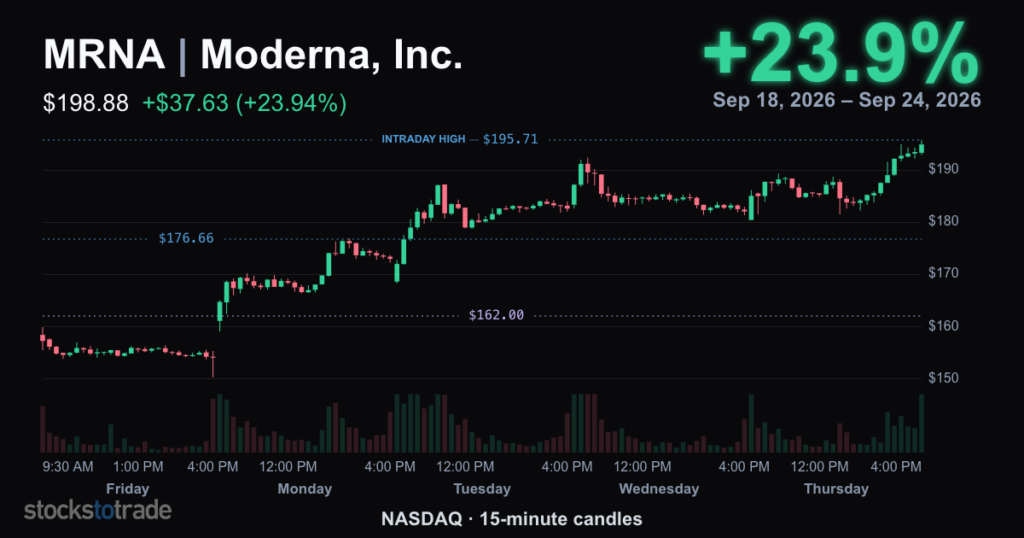
I was looking for a breakout above $162.00.
The next level I was watching was $176.66, the stock’s 52-week high.
I also wrote that I wouldn’t wait for $176.66 to sell some. I planned to sell small pieces as the stock climbed and keep a last piece in the trade.
MRNA broke $162.00 on Monday, September 21 (the very next day).
Three days later, MRNA closed at $194.82. The close was about 20% above my $162.00 trigger and about 10% above $176.66.
A trader who sold everything at $176.66 would have missed the move from there to $194.82.
When I can’t sit in a winner, it’s because I’m afraid the stock will turn around on me.
Selling some on the way up lets me hold the rest. Once I’ve locked in some gains, I’m not emotional about the trade anymore.
If I still can’t sit in a winner after that, my position is too big. I cut my position size until I can.
The same September 20 list had a trade plan for AMC Entertainment Holdings, Inc. (NYSE: AMC). I wrote both of my exits into it before the stock broke out.
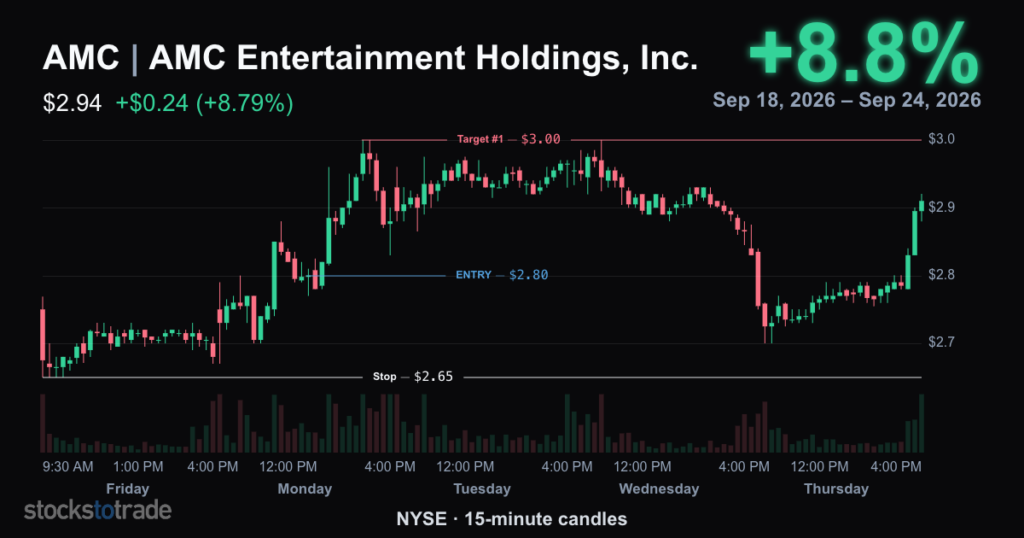
The trigger was a break (and hold) above $2.80 with volume. AMC’s highs on the two days before I wrote the plan were just under $2.80.
My stop was $2.65.
Selling at the stop would mean a loss of a little more than 5% from the $2.80 trigger.
On the way up, my first place to sell was around $3.00.
Above that, the next level I was watching was $3.18, the stock’s 52-week high.
AMC broke $2.80 on Monday, September 21.
Volume that day was about 2.6x the stock’s 30-day average, so the breakout had the volume I asked for.
From September 21 through September 24, AMC closed above $2.80 every day. It never hit my stop.
It traded up to $3.00 on September 21 and again on September 23.
Through September 24, it hadn’t traded above $3.00.
When I wrote down my plan for AMC, I didn’t set a limit on how much I could make. $3.00 was only the first place I’d sell.
When you write your next trade plan, set your stop at one price. If the stock hits it, sell the whole position.
Then write down more than one target.
Some charts will show you an obvious second target. Some will show you two.
If you only have one target, you’re not giving yourself the chance to extend your wins.
Sell some of your shares at each target.
Hold on to a few shares so you’re still in the trade if the stock keeps going.
Watch my live webinar TODAY for a look at my latest playbook.
Stay sharp,
Jack Kellogg
*Past performance does not indicate future results