
10 years ago I started my trading career with a little over $7,000 in my account.
I never thought I’d make millions back then…
How I turned $10k into $1.8million in 12 months*
These days I’m trading with huge positions and leveraging the size of my account to find an edge.
But back in those early days, I learned a thing or two about how to trade a small account…

A small account has a few major advantages:
First, being wrong is way cheaper.
My worst small-account days only cost me a few hundred dollars.
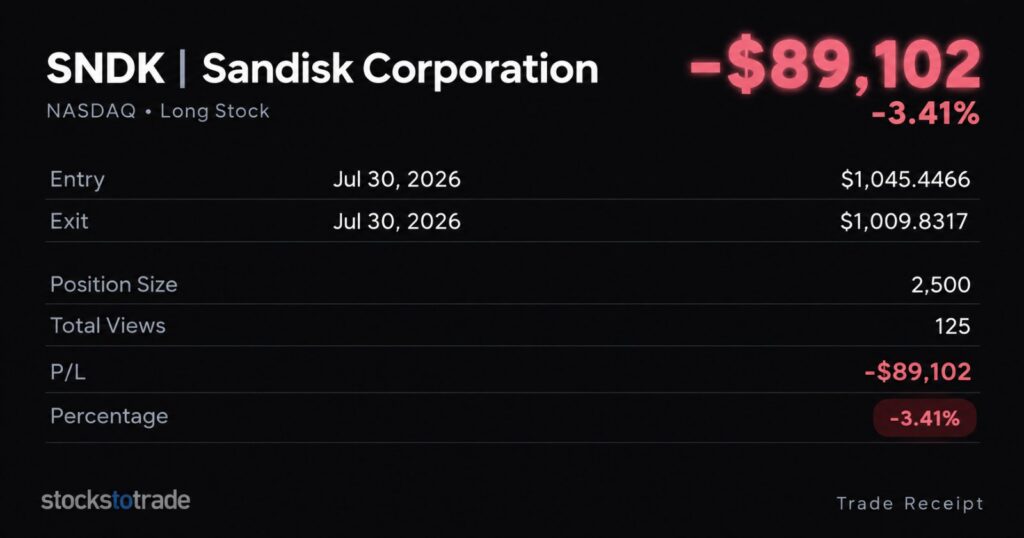
Compare that to last month, when I lost nearly $90,000 on SanDisk in a single day:
Second, your orders will almost always get filled.
A small account can easily build a meaningful position in a thin stock that only trades a few hundred thousand shares a day. (I can’t do that with my account size).
On the other hand, one of the disadvantages of small accounts is that you can only afford to buy a handful of shares of stocks in more expensive stocks, like SanDisk Corporation (NASDAQ: SNDK) at $1,800+ per share.
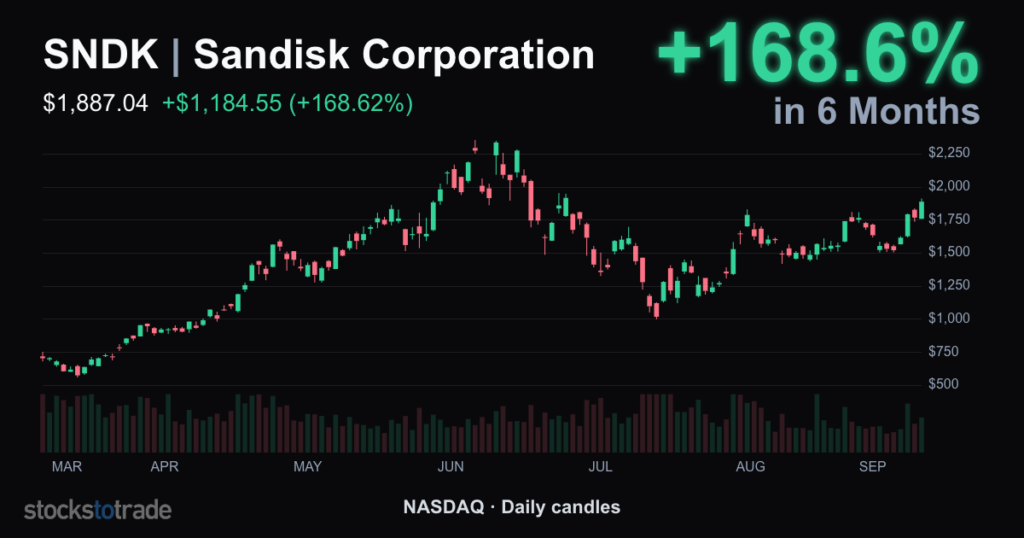
Even a big move on a stock like that doesn’t pay you much at that size.
But a 2x fund is built to move twice as much as the stock it tracks, every day. So if SNDK goes up 5%, the 2x goes up 10%.
Moderna’s 2x is the Defiance Daily Target 2X Long MRNA ETF (NYSE Arca: MRNX). From September 14 to September 21, Moderna ran 17.9%. The 2x fund MRNX ran 35.3%.
There’s one catch. The 2x only doubles one day at a time.
The 2x doubles the percent move, not the dollar amount. So a stock that moves from $100.00 to $105.00 (up 5%) would see its 2x counterpart move from $100.00 to $110.00 (up 10%).
Here’s where the math gets interesting…
The regular stock is now $105.00, and the 2x is sitting at $110.00.
Let’s say the regular stock drops 10% from $105.00 to $94.50.
Double that percentage to 20% and the 2x is now sitting at $88.00.
From where you started, the regular stock is down 5.5% ($100.00 to $94.50). The 2x is down 12% ($100.00 to $88.00), which is more than double.
So it’s not as simple as taking the gains or losses from the regular stock and doubling them for the 2x … the losses can get out of hand quickly if you’re not careful.
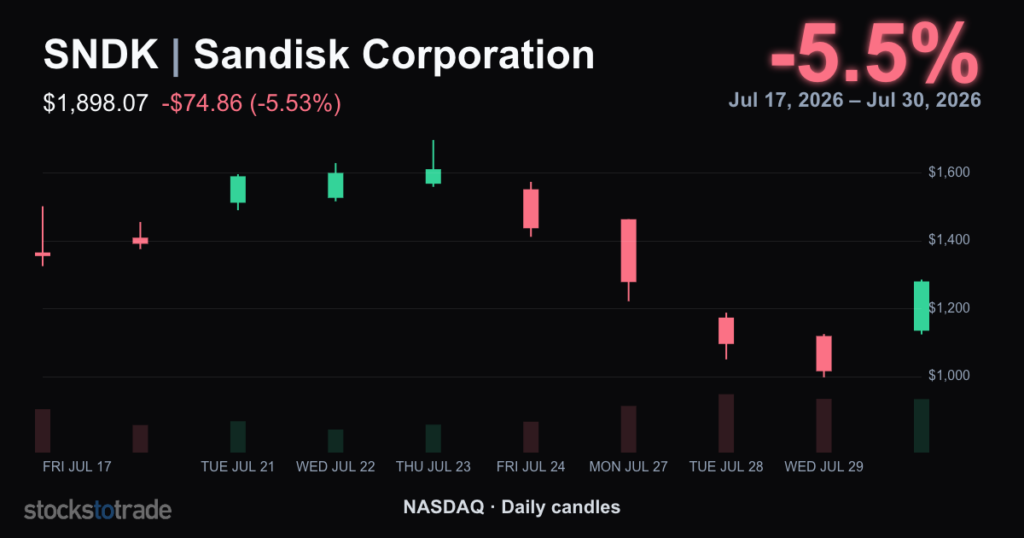
Look at what happened to SNDK in July.
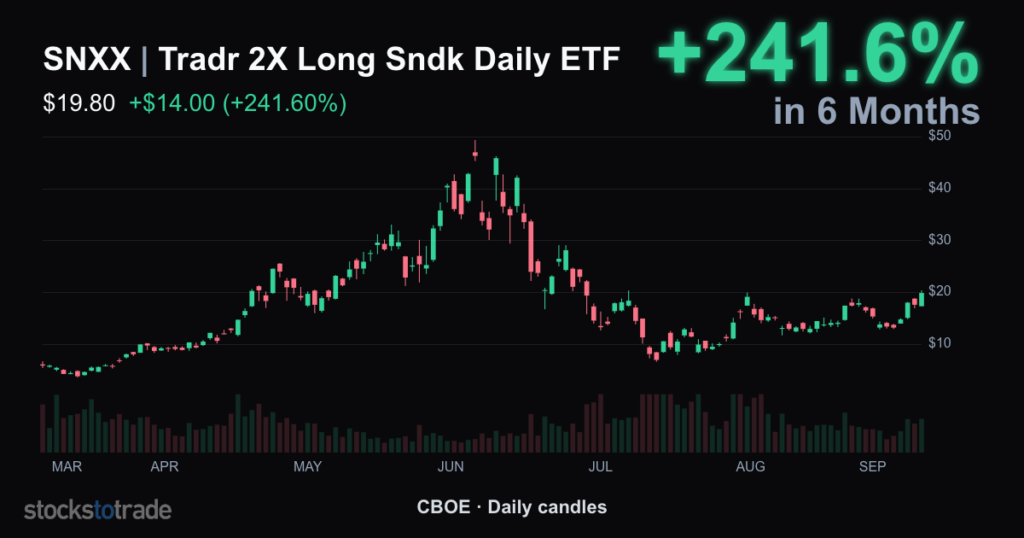
Its 2x is the Tradr 2X Long SNDK Daily ETF (CBOE: SNXX)
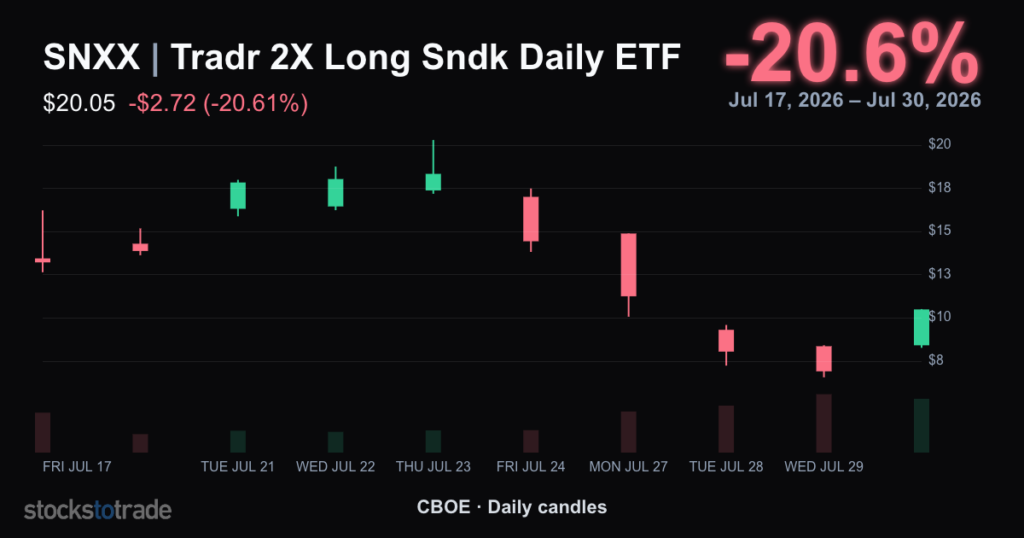
From July 17 to July 23, SanDisk ran 18.9%. SNXX ran 38.8%. So far, so good.
Then SanDisk rolled over. By July 29, it was down 36.9% from that high, and SNXX was down 62.3%.
On July 30, SanDisk bounced 26% in one day. SNXX bounced 52%.
Now do the math. SanDisk came most of the way back and finished those two weeks down 5.5%.
SNXX finished down 20.6%, 3.7x worse.
I learned this one trading leveraged funds myself. Once they start falling, they get destroyed.
How to Manage Risk When Trading 2x Funds
Before I buy a 2x, I already know where I’m getting out. I make my trade plans the night before, and every plan has a price where I’m wrong.
I set that price on the regular stock, not the 2x. My SNXX plan this week is the same plan I have for SanDisk. When SanDisk hits my risk level, the SNXX trade is over too.
Then I size it for twice the move. A 2x swings twice as hard as the stock, so the same dollars carry twice the risk. If you’d normally put $1,000.00 into the stock, $500.00 in the 2x gets you about the same move on any given day.
A lot of traders buy a stock and watch it drop. Then they buy more, hoping it turns around. A small loss turns into a huge one, and on a 2x, the losses grow twice as big.
When I cut a loss, I sell the whole position. I do that 99% of the time, and with a 2x it matters even more.
Waiting on a bounce is how a 5.5% loss on the stock turns into a 20.6% loss on the 2x.
Keeping my losses small compared to my account is the most important rule I have.
There are plenty of other ways to grow a small account.
This is one of my favorite tools.
Stay sharp,
Jack Kellogg
*Past performance does not indicate future results